Understanding Model Context Protocol (MCP) Servers
- Chad
- July 18, 2026
- MCP
- Model Context Protocol
- 0 Comments
Explore awesome mcp servers: model context protocol, mcp client, popular mcp and agent skills
Welcome — if you’ve been wondering how to connect ai models, llms and agent skills into real-world ai applications without drowning in custom glue code, you’re in the right place; this page is all about understanding the model context protocol and why an mcp server is the practical backbone that enables ai assistants, ai agents and workflows to run smoothly across remote and local-first setups. We’ll walk through what an mcp server does, how an mcp client talks to it, how to integrate databases, GitHub and other data source APIs, and how to pick and secure an awesome mcp server for your project, whether you want a remote mcp server, a local mcp server or something hybrid. CTA: Explore MCP basics
What is an mcp server and how does the model context protocol work for ai agents?
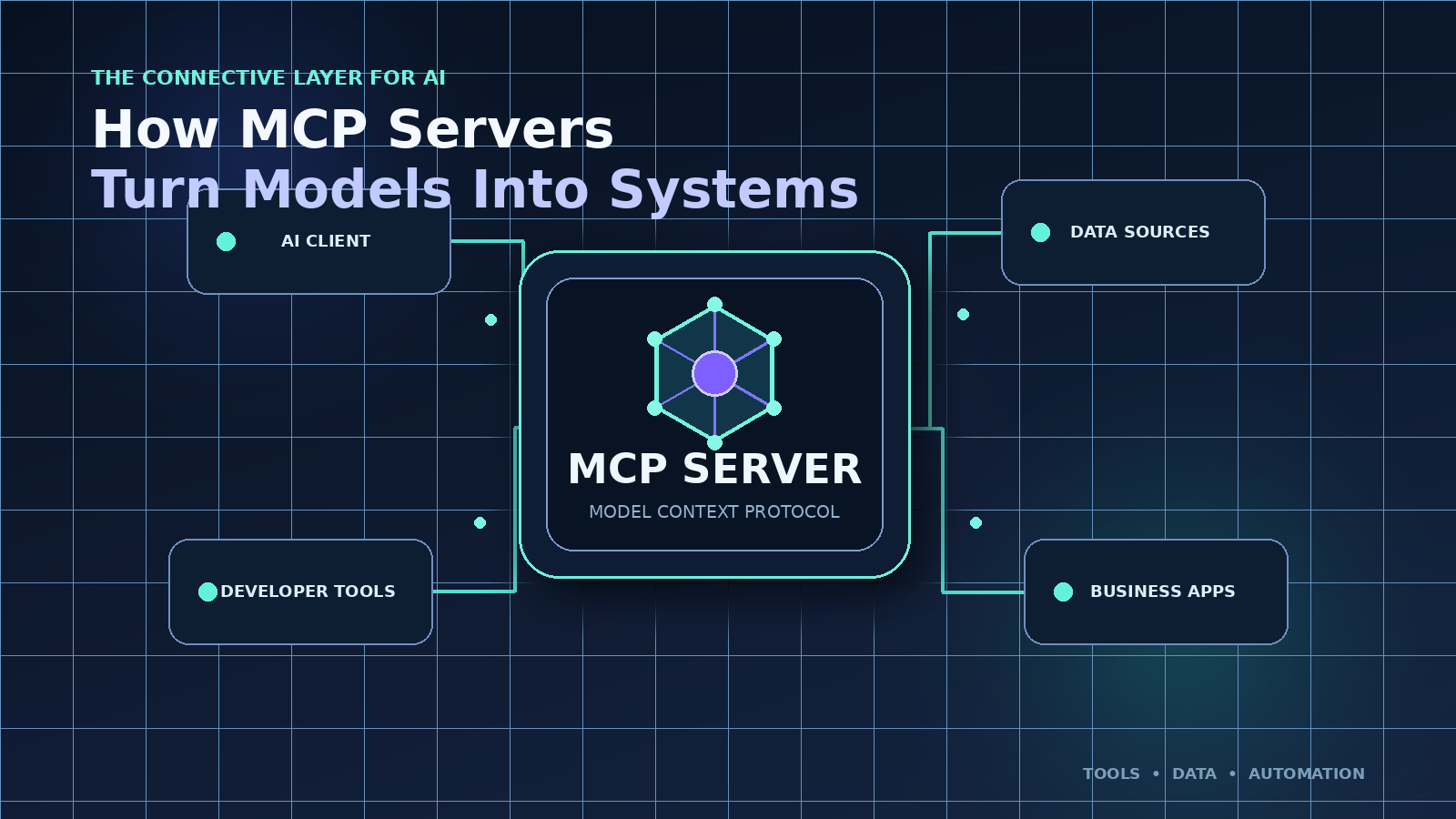
An mcp server implements the model context protocol, a standardized protocol that unifies context, prompts and data for ai models and ai agents so that natural language invocations, prompt enrichment and schema-driven context all arrive at the llm in a consistent, real-time way; in plain terms, the mcp server provides the glue that lets different ai tools, llms and ai clients share the same working memory, cursor position and prompt templates without bespoke integrations, which dramatically reduces latency and complexity as your ai assistant or ai agent scales. CTA: Learn how MCP works
What does a model context protocol (MCP) server do for an ai assistant or ai agent?
An mcp server provides context management, prompt orchestration and API routing so your ai assistant or ai agent can call multiple tools and data sources in a coordinated workflow: it stores recent conversation state, enriches prompts with schema-driven fields or knowledge base snippets, routes queries to the right llm or Claude-like model, and returns responses with invocation metadata that helps you debug and audit later, meaning your ai assistant can act more like a teammate than a black box. CTA: See MCP capabilities
How does an mcp server enable real-time context, prompts and llm workflow?
MCP servers enable real-time context by maintaining a dynamic model of the session and pushing updates to connected ai clients and ai models via APIs or websockets, allowing prompt templates to be filled with live data, cursored fragments and database results immediately; this reduces roundtrips, supports streaming responses for low-latency experiences, and lets workflows — like a multi-step automation that runs SQL, calls GitHub, and then synthesizes a final reply from an llm — run efficiently without losing track of where the ai agent is in the process. CTA: Try real-time MCP
What role do mcp client and ai model integrations play in the protocol?
The mcp client is what connects your ai app or ai client to the mcp server, handling authentication, OAuth flows, API key management and message framing so ai models, llms and external tools see a unified context; integrations to ai models (Claude, other llms) and data sources like a database or GitHub are configured at the MCP layer so the same prompt enrichment, schema injection and query routing works across all of them, making it simple to swap models or add new ai tools without rewriting your entire workflow. CTA: Connect an MCP client
How do I use the mcp server in my ai application and integration with apis?
Using an mcp server in your ai application means treating the MCP as the central orchestration point: you register your ai models, connect your knowledge base and databases, configure api endpoints for GitHub or other services, and then let agent skills or ai assistants call into the mcp via mcp clients; this design allows prompts to be enriched automatically with schema values, data source snippets or recent conversation context, and it enables automation where the MCP triggers SQL queries, pulls files from a file system or GitHub repo, and then composes a final natural language response from one or more llms. CTA: Start integrating MCP
How do I connect an mcp client to the mcp server via apis or oauth?
Connecting an mcp client is straightforward: you authenticate the client using API keys or OAuth depending on your security needs, then establish a session to exchange context updates, prompt invocations and streaming model outputs; many practical mcp implementations support both remote server connections and local-first mcp clients so developers can run a local mcp server for testing and switch to a remote mcp server in production, with support for authentication, token refresh and access control baked in for secure, auditable connections. CTA: Connect via API or OAuth
How do MCP servers integrate with databases, SQL, GitHub and other data source APIs?
MCP servers connect to databases and other data sources by configuring connectors that let agent skills run SQL, query knowledge bases and fetch files from GitHub or a file system, then return structured content to be inserted into prompts or used as input for an llm; the same integration pattern lets you call internal APIs, perform cursor-based pagination on large datasets, securely fetch secrets via vaults, and unify results so the MCP can enrich prompts with precise, relevant data without exposing credentials to the ai model or client. CTA: Integrate databases & GitHub
Can one mcp server unify multiple ai tools, llms and knowledge base sources?
Yes — one of the power of mcp is its ability to unify multiple ai tools and llms into a coherent workflow: by centralizing context, the MCP can route specific queries to Claude, another llm, or a specialized ai tool based on the query type and available agent skills, while simultaneously pulling relevant knowledge base entries and database rows to augment prompts; this unification reduces duplication, makes it easier to manage schema and prompt templates, and lets you orchestrate complex automations across tools with consistent authorization and auditing. CTA: Unify your ai tools
What are common mcp server use cases and popular mcp deployments?
MCP server use cases range from simple chat assistants to complex automation and workflow orchestration: common scenarios include ai assistants that combine company docs with llm summarization, ai agents that perform multi-step workflows like triaging tickets by querying SQL and GitHub, and remote mcp servers that serve many clients with low latency and centralized policy controls; popular mcp deployments include local-first mcp server setups for privacy-sensitive projects and remote mcp servers for scalable ai systems, and there are community-recommended awesome mcp servers that focus on different trade-offs like security, plugin availability or latency. CTA: Explore use cases
Which use cases benefit most from MCP: automation, workflow orchestration or agent skills?
Automation and workflow orchestration are where MCP shines because the mcp server manages state across steps, enables agent skills to call external APIs or run SQL, and injects relevant schema-driven context into prompts so the ai agent reliably produces correct outputs; whether you’re automating report generation from a database, orchestrating a multi-api integration that updates GitHub and then informs stakeholders, or building an ai assistant with specialized skills, MCP servers provide the standardized protocol and tooling to keep workflows deterministic and debuggable. CTA: Automate with MCP
What are examples of popular mcp servers used with Claude, other llms and ai tools?
Examples include community projects and commercial offerings that act as an mcp server to bridge Claude, OpenAI-style llms and custom ai tools; some projects focus on developer experience with local mcp servers and Claude desktop integrations, while others provide remote mcp servers optimized for scale and auditability, often including pre-built connectors for database, GitHub and common apis so teams can quickly enable ai-driven features in their ai applications without reinventing integrations. CTA: See popular MCP options
How do MCP servers support query routing, prompt enrichment and schema-driven context?
MCP servers support query routing by inspecting the query or agent skill and sending it to the appropriate ai model or tool, support prompt enrichment by merging in database results or knowledge base snippets according to a schema, and maintain a cursor or session state to preserve continuity across interactions; this schema-driven approach keeps prompts consistent, improves model accuracy, and makes it possible to debug and audit how each piece of data influenced the final ai response, which is essential for compliance and trust in production ai systems. CTA: Learn about routing & schemas
How do I find mcp servers, evaluate awesome mcp servers and choose one mcp for my project?
You can find lists of popular mcp servers and community-recommended options on developer forums, GitHub repositories, and curated lists of awesome mcp servers, but selecting the right one comes down to criteria like API compatibility, security features such as OAuth and authentication controls, performance and latency characteristics, ability to integrate with your database and GitHub, and the maturity of client libraries and mcp tools for your stack; if you prioritize privacy, a local-first mcp server or local mcp client may be best, whereas larger deployments often prefer a remote server that unifies many ai systems. CTA: Find MCP servers
Where can I find lists of popular mcp servers and community-recommended options?
Look on GitHub for curated lists and repositories that mention model context protocol, check community forums where ai developers discuss remote mcp servers and local-first mcp server patterns, and explore vendor docs for integrations that advertise Claude, OpenAI or other llms support; search terms like “awesome mcp servers”, “github mcp server” and “local mcp server” will surface both practical mcp implementations and examples of how teams use the mcp to integrate databases, apis and knowledge bases. CTA: Browse community lists
What criteria should I use to evaluate an awesome mcp server (performance, apis, security)?
Evaluate an mcp server by testing latency (how quickly it forwards context and model responses), API richness (support for streaming, cursoring, schema injection and prompt templates), security (authentication, authorization, oauth flows and access control), audit features (logging, prompt and query audit trails), and integration support for databases, GitHub and other data sources; also consider operational concerns like deployment model (remote server vs local mcp server), backup and scaling strategies, and whether the mcp tools and client libraries fit your development workflow. CTA: Evaluate MCP servers
When should I pick one mcp versus multiple specialized MCP servers?
Choose one mcp server when you want centralized governance, unified auditing and simpler integration across ai clients and llms; consider multiple specialized MCP servers if you need strict isolation between teams, different performance profiles for low-latency use cases versus heavy batch analytics, or legal/regulatory reasons that demand physically separate deployments; many organizations start with one mcp to unify workflows and split later if a localized, latency-optimized or security-segmented remote server is required. CTA: Decide MCP architecture
How is security, authorization and audit handled with an mcp server?
Security in an mcp server revolves around authentication, authorization and auditing: the MCP should support API key and oauth authentication, role-based access control to limit which ai agents or ai clients can call sensitive apis, encrypted connections to data sources like databases and GitHub, and robust audit logs that record prompts, queries, responses and invocation metadata to help you debug and prove compliance; further, secure secret handling prevents exposing credentials when agent skills call external services, and access policies can enforce least privilege across llms and tools. CTA: Secure your MCP
How do MCP servers securely handle oauth, authorization and access to data sources?
MCP servers typically delegate oauth flows to an auth provider, store tokens securely (often encrypted at rest), and use scoped authorization so agent skills only gain the permissions they need; connectors to databases and GitHub use credentialed service accounts or token exchange patterns so the mcp server can access data sources securely while minimizing exposure to ai models and clients, and full auditing lets you trace which token was used for each query to support incident response. CTA: Configure secure OAuth
What audit, logging and debugging features should an mcp server provide for llm prompts and queries?
An effective mcp server should provide structured logging of prompts, queries and model responses with timestamps, session cursors, and schema metadata so you can replay interactions, debug why a prompt produced a given output, and analyze agent workflows for optimization; features like configurable redaction, searchable audit stores, and hooks for external monitoring make it practical to operate at scale while retaining the ability to debug and tune prompt templates, agent skills and data integrations. CTA: Enable audit logging
How can I securely connect databases and knowledge bases to an MCP without exposing secrets?
Secure connections use vaults or secret stores, ephemeral credentials, and connector patterns where the mcp server holds the credentials and exposes only the data needed to the ai model in a sanitized form; you can also use schema-driven queries to limit the fields returned, tokenize or redact sensitive values, and enforce access control policies at the MCP layer so agent skills request only authorized scopes and any sensitive query results are treated with caution before being inserted into prompts. CTA: Protect data connections
How do agent skills, data sources and APIs work together with the mcp server?
Agent skills are small programs or capabilities that the MCP invokes to extend model behavior — they can run SQL against a database, call external APIs, fetch files from GitHub, or query a knowledge base — and the mcp server manages these invocations, injects results into prompts according to a schema, and ensures the entire workflow remains auditable and debuggable; this composition lets you build complex automations where ai agents combine natural language generation with real data actions. CTA: Build agent skills
How do agent skills call external APIs, run SQL or query a knowledge base through the MCP?
Agent skills are registered with the MCP and invoked via a standardized protocol: when an ai agent requests a skill, the mcp server runs the skill with appropriate inputs, performs any necessary authentication to external APIs or databases, returns structured results for prompt enrichment, and logs the invocation; this pattern keeps sensitive operations centralized and allows you to reuse skills across different ai assistants, llms and deployments. CTA: Implement skills
How does the MCP coordinate multiple data sources to provide unified context to an ai model?
The MCP coordinates data sources by executing parallel queries, merging results based on schema rules, filtering and scoring candidate snippets, and producing a consolidated context object that is then fed into the ai model as part of the prompt or as structured metadata; this unified context avoids inconsistent answers, reduces hallucination by grounding responses in real data, and enables more reliable ai systems across diverse knowledge bases and APIs. CTA: Unify data context
How can I debug and optimize agent workflows, prompt templates and ai responses via the MCP?
Debugging with an MCP is easier because you can replay sessions from audit logs, inspect prompt templates after enrichment, view the exact database queries or GitHub calls made by an agent skill, and measure latency and success rates per invocation; optimization then becomes systematic: tweak schema mappings, refine prompt templates, adjust routing to different llms like Claude or others, and monitor improvements in accuracy and latency across your ai application. CTA: Debug & optimize
Questions
Have questions about how an mcp server fits into your architecture, how to securely connect GitHub or your database, or whether to choose a local-first mcp server or a remote server for scale? Ask about performance, oauth patterns, how to reduce latency for streaming llm outputs, or how to integrate Claude, other llms and ai tools into a single workflow — we can help you map the right MCP strategy to your use cases and help you evaluate awesome mcp servers and practical mcp tools for your team. CTA: Ask a question
Reviews
People building ai apps often tell us that once they adopt an mcp server they stop rewriting the same integrations for every ai client, get consistent prompt enrichment across llms, and finally have audit trails to debug tricky failures; reviewers praise the ability to unify knowledge base, database and GitHub data into schema-driven prompts, and many cite improved latency and easier authorization management when moving from ad-hoc integrations to an MCP-based architecture. CTA: Read user reviews
Contact
If you want hands-on help choosing or deploying an mcp server, connecting Claude or other llms, building agent skills that call SQL and GitHub, or securing oauth and audit trails for your ai systems, reach out — we can advise on picking one mcp versus multiple servers, setting up local mcp servers for dev, or a remote mcp server for production with robust authentication, access control and debugging tools so your ai application is reliable and secure. CTA: Contact our team
Related Posts